


Intersectionality recognises that people experience overlapping and interconnected forms of disadvantage shaped by gender, race, class, disability, age, citizenship, and geography. When research fails to account for these intersections, its findings are incomplete, and the policies that follow from that research are less effective. The EU has taken important steps to broaden inclusion in policymaking and research. Yet, the Horizon Europe legislative proposal for 2028-2034 and its Specific Programme do not mention intersectional justice. Without an intersectional justice lens, Horizon Europe, the EU’s Framework Programme for Research and Innovation, risks reproducing systemic exclusions in research design, data collection, and policy relevance.
This policy brief shows how embedding intersectional justice can strengthen science across three dimensions: (1) project selection and evaluation; (2) conceptual framing; and (3) research methods.
Key recommendations
- Integrate and operationalise intersectional justice explicitly into the legal text of the next Horizon Europe programme.
- Encourage applicants in relevant calls to address intersectional dimensions beyond gender.
- Develop clear guidelines for applicants and evaluators on how to incorporate intersectional justice.
- Mandate intersectional data disaggregation whenever feasible.
- Diversify evaluation panels to include reviewers with relevant expertise and/or lived experiences.
- Avoid tokenism: require meaningful structural inclusion of affected communities in research.
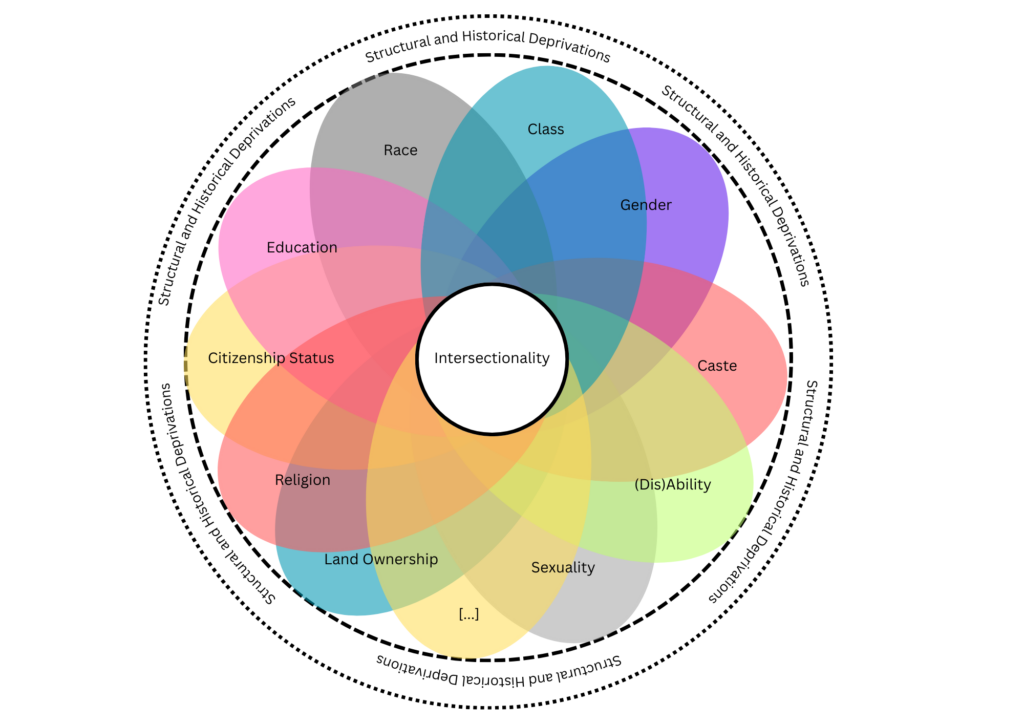
This policy brief builds on the MAPS project guidelines on intersectional justice.
Download the full policy brief below:
The full policy brief may be cited as:
Barlow, N., Patki, P., Dengler, C., Heck, L. (2026). Intersectional justice in EU research for better policies. The MAPS Project, Vienna University of Economics and Business, Vienna, Austria.