


As climate change, biodiversity loss and population ageing place growing pressure on public finances, questions about the future of welfare states are becoming increasingly important. Across Europe and beyond, policymakers face the challenge of maintaining healthcare, pensions, social care and income support while also reducing environmental impacts. A growing body of post-growth research argues that high-income countries can no longer rely on economic growth as the solution to social and ecological challenges. Yet welfare states themselves are often assumed to depend on growth.
In a new review published in The Lancet Planetary Health, we provide the first comprehensive overview of why welfare states may depend on economic growth and how policymakers might respond.
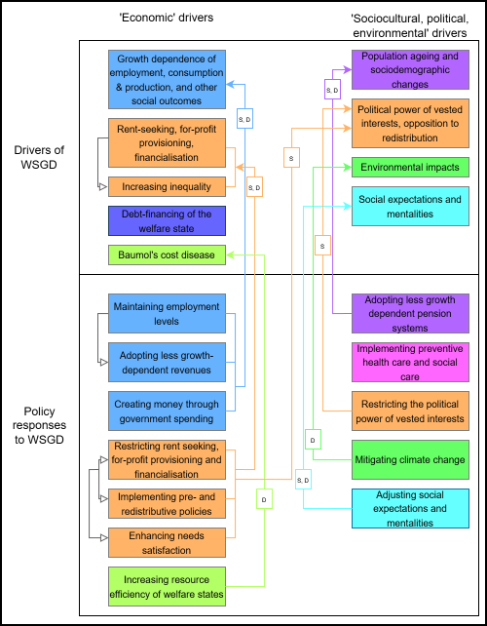
We applied a semi-systematic review methodology covering 98 academic publications from the fields of sustainable welfare, post-growth economics, degrowth and ecological economics. Their goal was to identify the mechanisms that make welfare states dependent on growth and to map the policy options proposed in response. A key contribution of the review is its distinction between two sides of the challenge: the supply of welfare funding and the demand for welfare spending. Growth dependence emerges when either the supply of funding falls short or when demands for spending increase. Welfare systems remain sustainable when these two sides stay in balance over the long term.
The review identifies several economic drivers of welfare state growth dependence. The most frequently discussed is the relationship between economic growth and employment. Because welfare states rely heavily on taxes and social insurance contributions linked to employment, slower growth can reduce revenues. At the same time, rising unemployment increases demand for welfare spending through unemployment benefits and associated social problems. This creates pressure on governments to pursue growth in order to maintain employment, revenues and social stability.
We also identify other economic factors that can increase growth dependence. These include the financialisation of welfare services, the growing role of profit-seeking in sectors such as social care, rising inequality, public debt, and what economists call “Baumol’s cost disease”, whereby labour-intensive services such as healthcare, education and social care become relatively more expensive over time compared to other sectors. These factors can either reduce available funding for welfare or increase the costs of, or demand for, welfare.
Beyond economic factors, the review highlights several social, political and environmental drivers. Population ageing is particularly important because it simultaneously increases demand for pensions, healthcare and social care while reducing the share of the population in paid work. The authors also identify climate change and environmental degradation as emerging drivers that can increase the demand for welfare spending through their impacts on health and livelihoods. Political resistance to redistribution, the influence of powerful interest groups, and social expectations that living standards and public services should continually improve, are also highlighted as factors that reinforce growth dependence.
The review then examines policies proposed to address these challenges. One set of proposals seeks to stabilise welfare funding without relying on growth. These include reducing working hours, expanding employment in care and other socially valuable sectors, job guarantee programmes, universal basic services, and tax reforms that place greater emphasis on wealth and other revenues that may be less sensitive to economic fluctuations. Some authors also discuss approaches associated with Modern Monetary Theory, which argues that governments with monetary sovereignty can create money directly to finance spending, while using taxes and other measures to manage inflation.
A second group of policies focuses on reducing the demand for welfare spending. These include preventive healthcare and social care, tackling inequality through predistributive and redistributive policies, reducing rent extraction and profit-seeking within welfare sectors, improving needs satisfaction through public services and not-for-profit provision, and mitigating climate change to avoid future social and economic harms. The review suggests that such preventive approaches may reduce the need for costly interventions later.
Overall, and most importantly, the review argues that future debates about sustainable welfare need to move beyond the assumption that economic growth is the only route to maintaining social protection. While many questions remain open and more empirical research is needed, the study provides a framework for understanding how welfare systems could continue to support wellbeing in a world increasingly shaped by environmental limits and demographic change.
Access the full article in The Lancet Planetary Health:
The full article may be cited as:
Büchs, M; Hirvilammi, T; Webb, T; Leoni, D, 2026. Growth dependence of welfare states: a semi-systematic review of drivers and policy responses, The Lancet Planetary Health, 101491, https://doi.org/10.1016/j.lanplh.2026.101491.