

Digital technologies are increasingly important to economies, public services, research and everyday life. They are also relevant to climate and energy policy: electricity systems must meet growing demand while rapidly reducing emissions. Some estimates have suggested that information and communication technologies could account for more than 20% of global electricity use by 2030. Such projections have raised concerns about whether expanding digital services, including data-intensive applications, could put substantial additional pressure on electricity systems.
In a recent study published in iScience, we provide an historical analysis of longer historical perspective. It examines electricity use in computing between 1975 and 2022, covering desktop computers, laptops, smartphones, datacentres and supercomputers. These devices are only part of the wider information and communication technology sector. The study does not include the electricity used in communications networks, such as mobile networks, routers or modems, which are responsible for transferring information rather than processing it.
The distinction is important. Computing transforms information: it performs calculations, runs software and processes data. Communication transfers information between places. Both activities are central to digitalisation, but they use electricity in different ways and are affected by different technological changes. Treating them as a single category can obscure how and why energy demand changes over time.
Efficiency of information processing
We find that electricity consumption by computing devices increased strongly over the past five decades, it multiplied by ten thousand. But the amount of information processed rose much faster: multiplied by 100 billion . Global computing activity therefore expanded by a factor far greater than the increase in the electricity needed to support it.
This divergence reflects major improvements in energy efficiency. Between 1975 and 2022, we estimate that computing efficiency increased by a factor of 10 million. Put simply, the electricity needed to carry out a given number of computations fell enormously. These efficiency gains made it possible for computers to process much larger volumes of information without a proportional rise in electricity consumption.
To assess this change, the study goes beyond the usual measures of computing performance per unit of energy. It compares the electricity used for a computation with a physical minimum: the minimum energy required to make an irreversible change to stored information. This threshold, known as the Landauer limit, is independent of any particular device or computing technology. It provides a common reference for comparing efficiency across several decades of technological change.
Electricity consumption of computing devices
The historical pattern is not one of uninterrupted growth in computing’s share of global electricity use. Electricity consumption by computing devices initially grew exponentially. But their share of world electricity consumption peaked at 2.5% in 2013. It then fell and stabilised at around 1.8% from 2018 onwards. In 2022, the computing devices covered by the study used less than 2% of global electricity.
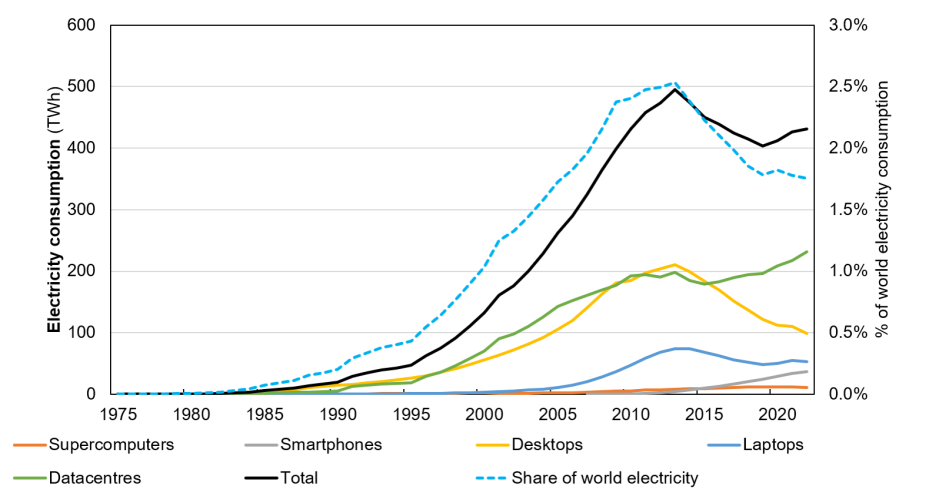
We identify two important reasons for this stabilisation. First, more computing has moved to large data centres. Concentrating computing in these facilities can improve the utilisation of hardware and support more efficient operations. Second, personal computing has shifted away from desktop computers towards laptops and, more recently, smartphones. These devices generally consume less electricity than desktops while enabling substantial amounts of information processing.
The results show why short historical periods can give a misleading picture of future electricity demand. Studies based on only a few years of data may capture rapid growth in computing activity but miss longer-term changes in technology, device ownership and system organisation. Over the longer period assessed in this study, efficiency improvements have repeatedly reduced the electricity required for each computation.
This study reveals that a steep increase in the electricity demand of computing devices is not expected in the near future. Its evidence provides an important basis for evaluating future scenarios. Policymakers assessing the energy implications of digitalisation need to distinguish between computation and communication, consider the changing mix of devices and infrastructure, and explicitly account for energy efficiency.
Future electricity demand from computing can’t be predetermined; it will depend on the growth of digital services, the types of devices and applications used, the design and location of data centres, and the continuation of efficiency improvements. Demand could rise if computing activity grows faster than efficiency gains.
Access the full article in iScience:
The full article may be cited as:
Pinto, R., Brockway, P. E., Domingos, T., & Sousa, T. 2026. Long-run electricity consumption in computing: Exponential growth followed by stabilization due to efficiency gains. iScience, 29. https://doi.org/10.1016/j.isci.2026.114876