


Existing climate mitigation scenarios link desirable social and climate futures to continued economic growth. This assumption is challenged by research showing that in rich countries, further economic growth does not improve well-being and increases environmental pressures. To address these limitations, post-growth and degrowth scenario literature seeks to analyse the system change required to secure human well-being within planetary boundaries. However, as the authors of this study show, existing post-growth scenarios fall short of implementing key principles of a post-growth transition, leaving much of the post-growth scenario space unexplored.
This is the core argument of the perspective by the Institute of Environmental Science and Technology, of the Universitat Autònoma de Barcelona (ICTA-UAB), the University of Lausanne, and the International Institute for Applied Systems Analysis (IIASA) conducted by researchers Aljoša Slameršak, Vivien Fisch-Romito, Jason Hickel, Jarmo S. Kikstra, Joel Millward Hopkins, Yannick Oswald, and Julia Steinberger, which was published recently in Nature Climate Change.
The lead author of the study, Aljoša Slameršak, says the work was motivated by how post-growth scenarios that reflect the depth of policy proposals are currently missing in climate mitigation literature: “Most of the current scenarios of post-growth and degrowth are represented in terms of stagnating or declining GDP. This framing misconstrues the core messages of post-growth, which is not to produce less in the same economy, but to produce different things and distribute them more equitably: less socially ecologically damaging goods and services, and more production for the satisfaction of human needs and ecological goals”.
Drawing on recent post-growth literature, the authors highlight the modelling approaches that should be reflected in the post-growth scenarios. Fisch-Romito, emphasises: “It is crucial that human wellbeing is analysed by the degree of basic human need satisfaction, such as access to housing, healthcare, food, etc”, and not (only) by income or economic activity in a country”. Jarmo Kikstra provides a complementary perspective on climate mitigation modelling. “Modelling post-growth means engaging carefully with the range of targeted demand-side measures and investments in low-carbon technologies that can reduce emissions. Representing innovation for mitigation purely through aggregate growth is not good enough for evaluating the effects post-growth policies will have.”.
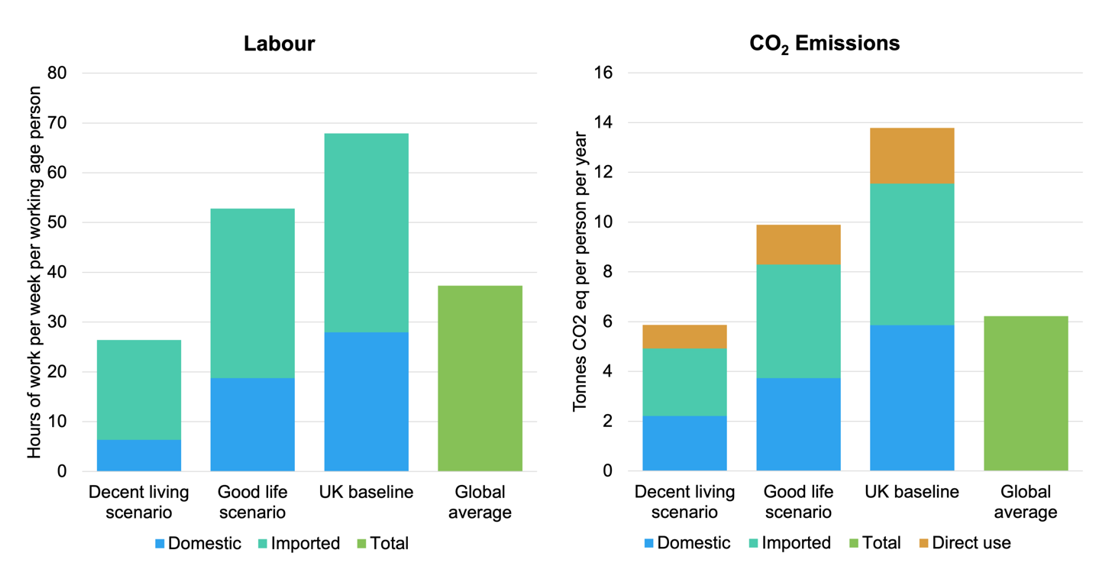
Having established that growth is not the vehicle of social progress and ecological transformation, Julia Steinberger elaborates on the key mechanisms for the post-growth transition: “Post-growth implies a redistribution and restructuring of the economy, to provide the essentials for a decent standard of living to everyone, while keeping additional, non-essential consumption to levels compatible with planetary boundaries. This requires the current striking inequalities to be substantially reduced. Economic activity must be reorganised by giving priority to essential production for human needs and the pursuit of ecological targets. Finally, resource use in the Global North and Global South should gradually converge to a level that is sufficient for high well-being and compatible with planetary boundaries.”
The authors explain that while several studies have quantified the transformative potentials of individual post-growth principles, they are not directly representative of post-growth scenarios.
Yannick Oswald explains: “We lack modelling tools that are capable of integrating several of these principles, to test the conditions in which principles could mutually advance the pursuit for social and ecological aims and to anticipate possible negative interactions between individual principles”.
TBA
However, as pointed out by Joel Millward-Hopkins, the results from previous studies are promising: “The encouraging news is that existing studies show that post-growth principles can be highly transformative even when applied individually. For example, we know that basic needs could be satisfied universally with less than half of energy and materials that are currently consumed globally.”
Finally, Jason Hickel recognises that despite its social and ecological potential, major barriers exist to a potential post-growth transition.
“Of course, the post-growth transition makes some hard assumptions that imply radical departure from current social, economic, and institutional arrangements. It envisions downscaling socially and ecologically harmful sectors, such as weapons manufacturing and aviation, expanding public services, ending the exploitation of poorer countries, strengthening the role of the state and non-profit economies, and committing to multilateral diplomacy. Such shifts are likely to face resistance from pro-capitalist and imperialist actors”.
“However, growth-oriented scenarios also depend on radical assumptions, most notably the large-scale deployment of negative emissions technologies, intended to limit or reverse global warming. The key difference between post-growth and growth-oriented approaches is that post-growth envisions deep systemic change that, at least in principle, can be achieved through democratic deliberation and social struggle, whereas the feasibility of unproven technologies in growth-oriented scenarios remains speculative and possibly not physically achievable”.
Read the full preprint in Nature Climate Change below:
The full preprint may be cited as:
Slameršak, A., Fisch-Romito, V., Hickel, J., Kikstra, J.S., Millward Hopkins, J., Oswald, Y. and Steinberger, J. (2026) ‘Principles for a post-growth scenario of ambitious mitigation and high human well-being’, Nature Climate Change, 16(4). Available at: https://doi.org/10.1038/s41558-026-02580-6.