


Scenarios are qualitative and quantitative assessments of possible futures. They do not try to predict exactly what will happen. Instead, they help us explore long-term trends, environmental limits, and sometimes unexpected effects of policies and sustainability actions. In sustainability research, scenarios have typically followed existing economic structures and growth-oriented trajectories. To reach climate change mitigation goals, these scenarios often depend heavily on new technologies. However, many of these technologies are still uncertain, either because they are not yet fully developed or because using them on a large scale could create new environmental problems.
Research has shown that while technology is important, it alone cannot solve challenges like climate change and other sustainability issues. Because of these limits, researchers have increasingly turned their attention to other levers such as living with less, changing consumption habits, and rethinking the economic paradigm. Concepts like sufficiency, lifestyle change, and post-growth focus on reducing demand and reshaping social and economic systems in different ways to achieve sustainability.
Post-growth approaches in particular aim to move the goal of the economy away from continuous growth and toward improving human wellbeing while staying within the planet’s ecological limits. Previous review studies have already examined existing post-growth and degrowth scenarios. Besides, relevant ideas and findings can also be found in studies that use different labels but share similar assumptions or pursue closely related goals.
In this systematic review, currently available as a preprint, we examine 60 economy-wide scenarios that fall under post-growth (explicitly post-growth scenarios) or closely related approaches (post-growth-like scenarios). By bringing these studies together, the review broadens the body of literature available to researchers interested in post-growth and highlights both connections and gaps across different research traditions.
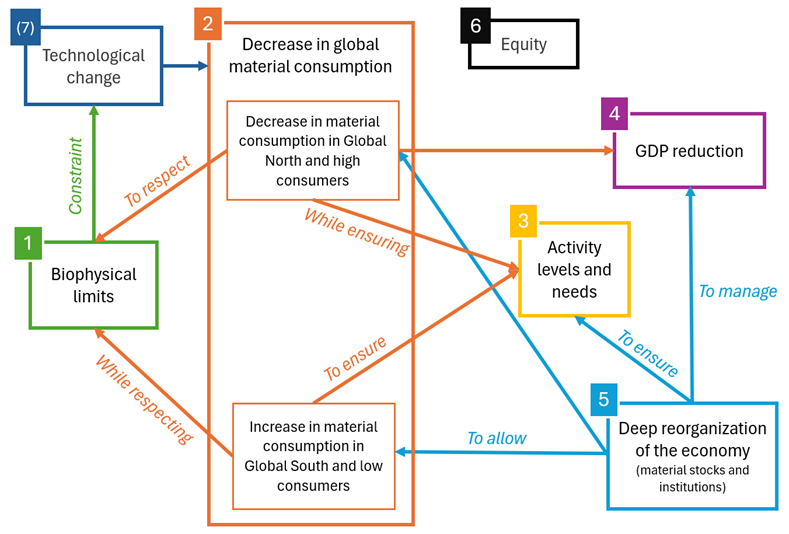
Seven post-growth pillars
We use a framework with seven pillars:
- (1) Biophysical limits,
- (2) Low consumption,
- (3) Activity levels,
- (4) Gross Domestic Product (GDP) reduction,
- (5) Reorganisation of the economy,
- (6) Equity
- (7) Technological change.
This framework allows to compare the main characteristics of the scenarios, to examine the types of models they use, and to better understand how post-growth and related concepts complement or superpose one another.
The review covers 60 papers published between 2010 and July 2025, including 27 studies that explicitly use post-growth or degrowth labels. Most of the literature has emerged since 2020, with publication activity peaking in 2022, though overall growth in the field has not followed a steady upward trend.
Results
Less than one third of the assessed studies include five, six or seven post-growth pillars. Only one study in the sample represents all seven pillars, and even in that case, not all mechanisms or levels of transformation are fully explored. This indicates a limited degree of holistic integration across key post-growth elements.
Despite the transformative nature of post-growth, we find a lack of representation of structural changes in terms of changes in institutions, infrastructure and transformative policies. This is consistent with the general difficulties in the field of macroeconomic modelling for representing deep transformations that break with historical trends. Due to the impossibility to have empirical research in inexistent conditions, it is difficult to estimate parameters and define dynamics.
Extending the literature search beyond scenarios that explicitly use the term post-growth to include related concepts such as sufficiency helps filling underexplored gaps particularly in representing activity levels like distances travelled by citizens, diets or appliances in households. Another large difference between explicitly Post-Growth and Post-Growth-Like scenarios is the inclusion of GDP reduction. While post-growth scenarios typically include reductions in GDP, post-growth-like scenarios often avoid monetary indicators altogether or, in some cases, combine substantial reductions in final energy use and greenhouse gas emissions with continued GDP growth.
Pathways for quantitative and qualitative future research
Within this context, we finally provide avenues for improvement of models and of future research in the post-growth field, both in terms of quantitative scenarios and qualitative research. We include recommendations for the broader sustainability community such as the Intergovernmental Panel on Climate Change (IPCC) for the inclusion of post-growth scenarios.
For example, while inequalities have been explored in terms of the effect of international convergence of income or services on greenhouse gas emissions, the implications of inequality reduction for financial systems and debt dynamics remain largely understudied. Similarly, households are usually considered in models only as consumers throught their wages and expenditures or as a final energy demand . There is a clear need for future models to better represent the unpaid care economy and other non-market activities that are central to wellbeing but largely invisibilized in current economic frameworks.
Access the full preprint in SSRN:
The full article may be cited as:
Pérez-Sánchez, Laura and Slameršak, Aljoša, A broader landscape of post-growth pathways: review of sustainability scenarios integrating biophysical limits, sufficiency, equity and structural change (April 14, 2026). Available at SSRN: http://dx.doi.org/10.2139/ssrn.6576363