


The development of artificial intelligence (AI) has the potential to transform society and the environment. While some highlight its technological promise, others raise serious concerns about its environmental footprint or potential to exacerbate inequality. How should we assess these impacts? In an article published in Nature Machine Intelligence, Felix Creutzig and Dan O’Neill argue that the standard economic tool used for this purpose — cost–benefit analysis — is fundamentally inadequate. Instead, we propose a “strong sustainability” approach to guide AI development in a way that respects environmental limits and promotes human wellbeing.
Weak and strong sustainability
Weak sustainability and strong sustainability are two competing paradigms in sustainability science. Weak sustainability argues that different forms of capital — natural, built, human, social, financial — can be substituted for one another, so long as the value of the total stock of capital does not decrease. Strong sustainability, by contrast, argues that each form of capital has intrinsic value and critical thresholds that must not be crossed.
Cost–benefit analysis is a weak sustainability approach. While suitable for market goods, it becomes deeply problematic if applied to AI. It collapses diverse effects into a single monetary metric, obscuring ethical and distributional trade-offs. It overlooks critical social thresholds and environmental limits, and the choice of discount rate can diminish the importance of future AI impacts. Moreover, cost-benefit analysis cannot meaningfully account for existential risks associated with AI development. Human survival and autonomy are typically regarded as non-negotiable — they cannot be traded off against financial assets.
Applying the Doughnut to AI development
To address these shortcomings, we propose a strong sustainability approach using the “Doughnut” of social and planetary boundaries. The Doughnut combines the planetary boundaries framework from Earth-system science with social thresholds linked to meeting human needs. It visualises sustainability as a ring-shaped space where resource use is high enough to meet people’s needs, but not so high that it transgresses planetary boundaries.
The figure below illustrates how the Doughnut can be used to evaluate scenarios of AI development. In the hypothetical scenario shown, AI development improves some social outcomes (health, education, energy access, and connectivity) but worsens others, with employment, equality, and social cohesion declining due to the unequal distribution of benefits. At the same time, AI development improves some environmental outcomes (land conversion and nutrient pollution decrease due to precision agriculture), while worsening others (climate change and water use increase due to the expansion of large data centres).
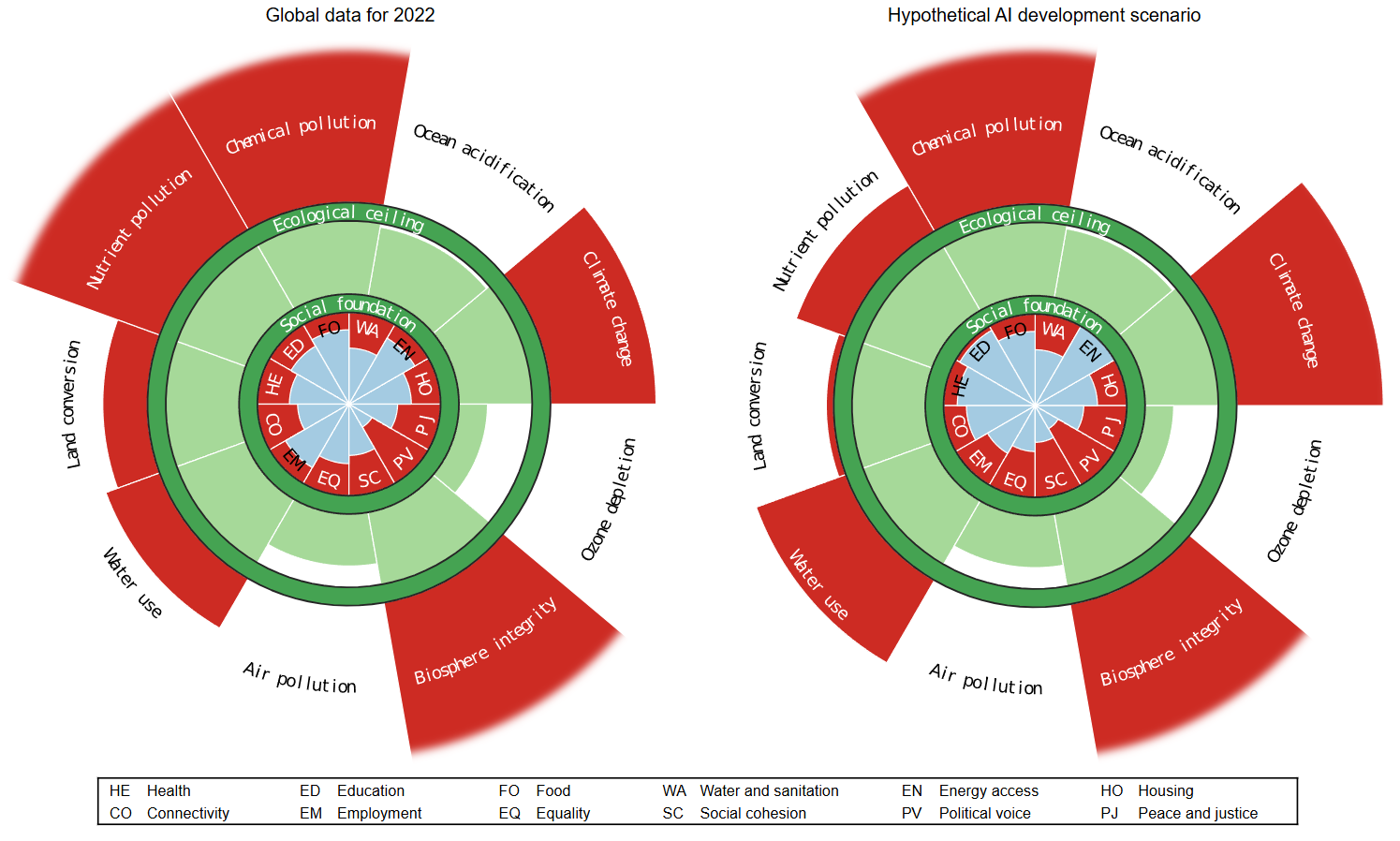
A central tenet of strong sustainability is that improvement in one domain cannot compensate for deterioration in another. Better health does not excuse worsening climate change; more education does not make up for loss of social cohesion. In the context of AI development, the goal should be to use AI to help eliminate social shortfalls and reduce resource use to be within planetary boundaries.
Modelling AI futures
AI development could lead to a wide range of different futures. To better understand these, and steer society towards positive ones, we need robust scenarios and models. This analysis must go beyond carbon accounting. We should evaluate the impact of AI using a wide array of social and environmental variables, such as those captured by the Doughnut. Scenarios should also account for critical risks, including the transgression of planetary boundaries, social unrest due to widening inequality, and existential threats such as misaligned AI becoming autonomous.
Unfortunately, many existing integrated assessment models focus narrowly on GDP and CO₂ emissions. However, a new generation of ecological macroeconomic models is emerging that incorporates broader social and environmental indicators. Within the MAPS project, we are beginning to use the COMPASS model of the Doughnut to simulate different scenarios of AI development, with the aim of informing policy decisions about whether technological trajectories are moving societies towards or away from a safe and just space.
Defining our goals first
The sustainability of AI cannot be meaningfully assessed through carbon metrics or cost–benefit analysis alone. A strong sustainability approach, using the Doughnut of social and planetary boundaries, provides a more comprehensive and policy-relevant foundation. Ultimately, we must reverse the prevailing logic: rather than allowing AI to shape our future and hoping it aligns with sustainability, we must define our goals as a society first — a good life for all within planetary boundaries — and then steer AI development to help achieve them.
Access the full article in Nature Machine Intelligence:
The full article may be cited as:
O’Neill, D.W., Creutzig, F., 2025. A strong sustainability approach to AI development. Nature Machine Intelligence, 8, 642–644 (2026): https://doi.org/10.1038/s42256-026-01240-w