


Introduction
Energy is central to modern economies. From heating homes and transporting people to powering industry and digital services, economic activity depends on transforming energy into useful outcomes. Yet when policymakers and researchers examine the links between energy, growth and sustainability, the indicators they rely on often capture only part of this relationship. Energy prices track fuels and electricity, not the services they deliver, while economic models typically treat energy as a relatively minor input compared with labour and capital. This gap matters as Europe seeks to combine climate mitigation, efficiency improvements and long-term economic stability.
A recent study published in Ecological Economics addresses this challenge by proposing a new way to represent energy services in economic accounting. Rather than focusing only on fuel prices or treating energy as a primary factor of production, the study shows how energy services can be incorporated into national accounts as an intermediate flow. This makes it possible to estimate economy-wide prices for energy services that reflect not only fuel costs, but also efficiency gains and the capital and labour required to deliver those services. To capture energy services more directly, the study uses exergy, a thermodynamic measure of energy quality – that is, the maximum work an energy flow can deliver, given the surrounding environment. As energy is transformed through the economy, exergy is progressively lost due to inefficiencies. The term useful exergy refers specifically to the portion of exergy that actually reaches end-uses – such as heat, motion, or light – after all conversion losses. It is this useful stage that corresponds most closely to the energy services people and firms rely on. The approach offers new insights into how changes in energy systems relate to economic growth over time.
How the study was carried out
The study combines economic and physical data to analyse how energy is transformed and used across the whole economy. To do this, the authors reorganised national accounts and energy statistics into a two-sector framework that separates energy conversion activities (E-Sector) from the rest of economic production (NE-Sector) – Figure 1.
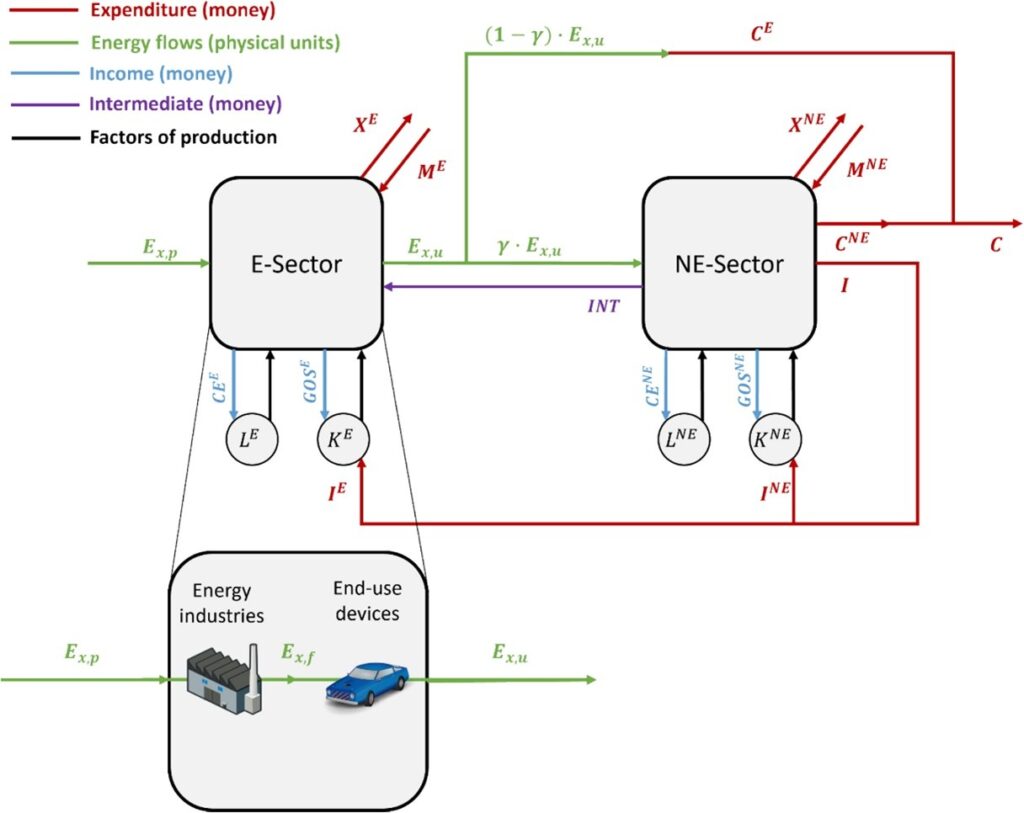
One sector groups together all activities involved in converting energy resources into usable forms, from extracting fuels and producing electricity to converting final energy into useful outputs such as heat, movement or light through end-use technologies. These activities rely on capital, labour and imports, like any other productive sector. The second sector includes all remaining economic activities, such as manufacturing and services, which use energy services as an intermediate input alongside labour and capital.
To operationalise this framework, the authors reclassified official national accounts so that investment, employment, wages and profits were consistently allocated to each sector. In parallel, they reconstructed detailed energy and useful exergy balances, which track not only how much energy is consumed but how efficiently it is converted into a useful form. Linking these physical flows with monetary data allowed energy services to be treated consistently within the economic accounts.
Using this integrated dataset, the researchers estimated prices for energy services in two independent ways: from the demand side, based on what households, governments and firms pay for them; and from the supply side, based on the costs of producing them. The close agreement between these two estimates provides a check on the internal consistency of the method. The framework was applied to Portugal over the period 1960–2014 using harmonised historical data.
What the results show
Applying the framework to Portugal reveals clear long-term patterns linking energy services and economic development. One central finding is that the estimated price of energy services declined steadily for much of the period analysed, before stabilising in more recent decades – Figure 2. This decline reflects a combination of improved efficiency in converting energy into useful services, changes in the energy mix, and shifts in the capital and labour used in energy conversion. As energy service prices show, energy (fuel) prices alone provide an incomplete picture of energy’s economic role. Efficiency improvements and technological change often offset higher fuel prices, reducing the cost of the services actually used by households and firms.
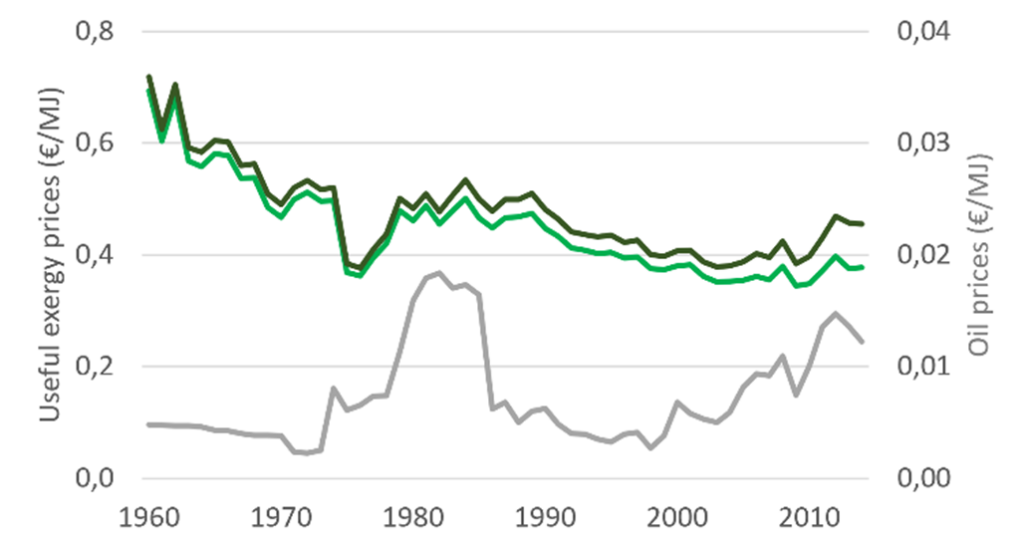
Periods of declining energy service prices align closely with phases of sustained economic growth. As energy services became cheaper in aggregate terms, the economy expanded while using energy more effectively. By contrast, periods characterised by slower efficiency gains show flatter trends in both energy service prices and economic output. These results support earlier evidence that improvements in how energy is converted and used are closely linked to long-run economic growth.
Crucially, the study shows that energy services can be integrated into economic accounting beyond treating them as a primary factor of production. Modelling them as an intermediate input preserves consistency with national accounting principles while better reflecting the physical realities of energy use.
Why this matters
By linking physical energy flows with economic accounts, this approach provides a clearer view of how energy systems and economic growth evolve together. Tracking the price of energy services captures the combined effects of efficiency, technology and economic structure, offering a useful complement to traditional energy and economic indicators. This perspective is particularly relevant in the context of energy transitions, where how energy is converted and used may be as important as how much energy is consumed.
Access the full article in Ecological Economics below:
The full article may be cited as:
Santos, J., Sousa, T., Serrenho, A., & Domingos, T. (2025). An aggregate price for energy services: Useful exergy as an intermediate flow in a two-sector model of the economy. Ecological Economics, 236, 108665. https://doi.org/10.1016/j.ecolecon.2025.108665