


Every economy depends on a constant supply of natural resources. Materials such as minerals, biomass and fossil fuels, together with energy, are extracted from the environment, transformed into products and services, and eventually returned as waste or emissions. Yet materials and energy, two fundamental dimensions of economic activity, are usually analysed separately. This limits our understanding of how efficiently societies use resources. As countries work towards climate neutrality, resource security and circular economy goals, it is becoming increasingly more important to find better ways of measuring the physical basis of economices.
In a recent study published in Ecological Economics, we introduce the Material and Energy Metabolism Model for Economies (MEMME), a new framework that combines material and energy accounting into a single, consistent representation of socioeconomic metabolism.
Socioeconomic metabolism describes the physical processes that sustain society. Just as living organisms require energy and nutrients to function, economies require continuous flows of materials and energy to build infrastructure, manufacture products, produce food and provide services. Existing accounting approaches generally focus either on material flows or on energy flows, making it difficult to examine how they interact throughout the economy.
MEMME addresses this gap by following resources through the major transformation processes that occur within an economy. The framework distinguishes four key stages:
- havesting and extraction of natural resources;
- energy transformations;
- material transformations such as manufacturing and construction; and
- food and feed transformations.
It also explicitly includes material stocks such as buildings, machinery and infrastructure. Material stocks play a central role in enabling economic activity but are often treated separately from resource flows. By keeping both mass and energy accounts balanced and consistent, MEMME allows these interconnected processes to be analysed together.
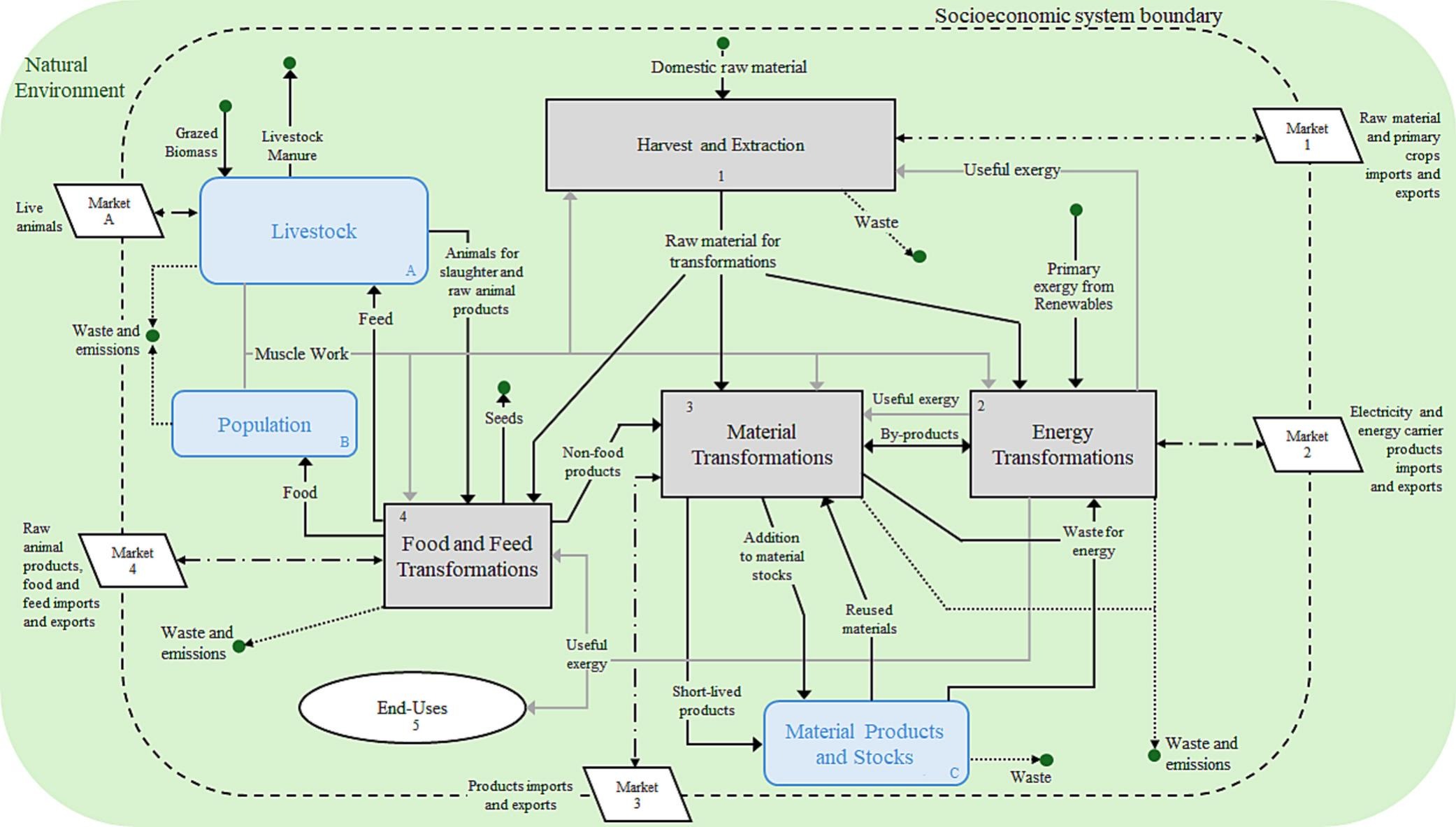
The framework also introduces a few indicators only using material and energy (biophysical) flows, reinterpreting their usual forms which use monetary flows. These biophysical indicators are designed to improve our understanding of resource use. Some measure how much useful energy is required to harvest crops or extract minerals, while others quantify the efficiency with which materials are transformed into products. Together, these indicators provide information that conventional throughput measures alone cannot capture, because they focus on the transformations that give resources economic value rather than only on the quantities entering or leaving the economy.
A further contribution is a new indicator called Biophysical Economic Productivity (BioEP). Rather than relating economic output only to labour or capital, BioEP links gross domestic product (GDP) with the biophysical outputs that directly support economic activity: useful energy and material products. The indicator is intended to assess how effectively an economy converts biophysical resources into economic value, enabling a complementary perspective to more familiar economic productivity measures.
The framework was tested using Portugal as a case study over the period 1970-2022, a time characterised by economic and energy transitions. During these decades, Portugal experienced rapid infrastructure development, increasing material stocks, a shift from oil towards natural gas and, then, renewable electricity, and an accentuated growth of the tertiary economic sector. These long-term changes provide an opportunity to examine how resource use evolved alongside economic development.
The analysis shows that Portugal’s overall resource use and accumulated material stocks increased substantially throughout the study period. At the same time, improvements in transformation efficiency were small, with a stagnation in energy transformations and a small increase in material transformations. The BioEP indicator provides an additional perspective. It suggests that Portugal became more efficient at converting natural resources into useful physical outputs, but less efficient at translating those outputs into economic value over time. The indicator also identifies a period of absolute decoupling between 2000 and 2008, during which economic output increased while the combined biophysical outputs declined. These results illustrate how integrating material and energy accounting can reveal patterns that are not apparent when each resource is analysed independently.
The framework provided by MEMME is intended as a conceptual tool that can support future research and policy analysis. Because MEMME integrates materials, energy, stocks and transformations within a single accounting structure, it enables a more comprehensive assessment of how economies use resources and where improvements in efficiency occur (or fail to occur). As governments seek evidence to support climate, resource and circular economy policies, approaches that consider the full physical metabolism of economies may provide a broader basis for understanding progress towards sustainability.
Access the full article in Ecological Economics:
The full article may be cited as:
Felício, L., Krausmann, F., Sousa, T., 2026. Designing MEMME – A conceptual material and energy metabolism model for economies. Ecological Economics 248, 109059. https://doi.org/10.1016/j.ecolecon.2026.109059