


Exploring post-growth futures: insights from the MAPS project
How can societies move beyond growth-driven models toward sustainable futures? This question lies at the heart of the MAPS research project, which seeks to understand pathways for sustainability in a world facing ecological limits and social challenges. MAPS researchers from the Corvinus University of Budapest explored possible post-growth futures and identified strategies to avoid undesirable outcomes.
Why foresight matters
Economic and social systems are shaped by collective imaginaries—our shared visions of what is possible and desirable. When these imaginaries remain locked within dominant paradigms, solutions tend to reproduce existing problems. Foresight offers a way to break this cycle by exploring diverse futures, including both positive and negative scenarios. Negative scenarios warn us of risks, while positive ones open space for new possibilities. Others show how well-intentioned interventions can still lead to unintended consequences if pursued without a holistic view.
An integrated approach
To address these challenges, the MAPS team developed an integrated foresight method combining three tools: horizon scanning, scenario building, and an E-Delphi process. This approach responds to 21st-century demands for sustainability, democratic participation, and knowledge integration. It also acknowledges that future planning must involve diverse perspectives to navigate complex and sudden changes.
Step 1: Horizon scanning
The process began with horizon scanning, systematically identifying emerging issues and trends. MAPS researchers representing institutions from eight countries reviewed existing studies on sustainability and post-growth, then conducted an online brainstorming exercise. Participants were asked to propose future issues across social, technological, ecological, economic, political, legal, ethical, and demographic dimensions (known as STEEPLED). This exercise generated 596 statements, later refined to 60 key items.
These statements were classified into five categories:
- Hypes (18%)
- Trends (19.7%)
- Megatrends (26.2%)
- Wild cards (8.2%)
- Weak signals (27.9%)
Step 2: Building scenarios
Next, participating MAPS researchers co-created future visions through participatory scenario building. From the 60 statements, 16 were selected as key drivers. Using a two-dimensional method, participants developed eight scenarios (see figures below).
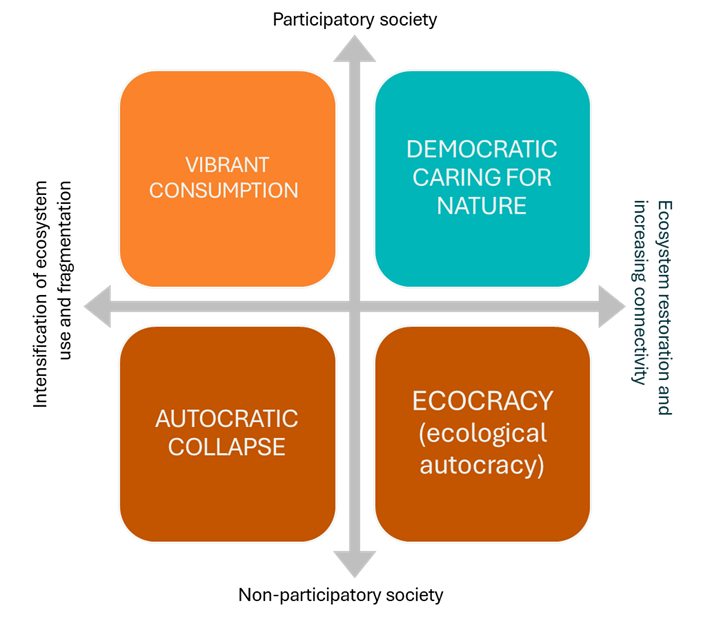
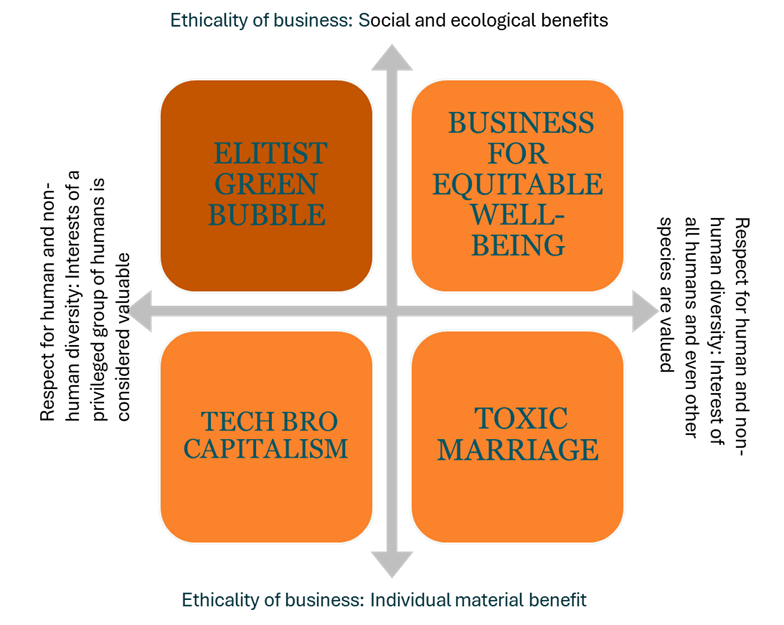
These eight scenarios were later narrowed to four that best captured post-growth dynamics:
- Autocratic Collapse – a pessimistic scenario of systemic breakdown.
- Democratic Caring for Nature – a desirable vision aligning with sustainability and equity.
- Ecocracy – ecological priorities dominate, but democratic values erode.
- Elitist Green Bubble – green policies benefit elites while inequality persists.
These scenarios illustrate both opportunities and risks. For example, Ecocracy shows that ecological restoration without democratic involvement can undermine social values.
Step 3: Expert validation
Finally, an E-Delphi process engaged 52 experts from academia, NGOs, and business to evaluate the scenarios. They assessed desirability, political feasibility, and proposed policy interventions. Only Democratic Caring for Nature emerged as a clearly desirable post-growth pathway. The other scenarios highlight how partial transformations—ecological without social, or vice versa—can lead to problematic futures.
Experts also identified five priority policy solutions to advance a more equitable, sustainable, and democratic post-growth future. These include measures to strengthen participatory governance, integrate ecological and social goals, and ensure fair distribution of resources.
What this means for policy
The findings underscore the importance of integrated foresight for sustainability planning. Policymakers should not assume that incremental changes within existing paradigms will suffice. Instead, they need to engage with diverse futures, anticipate risks, and design interventions that harmonise ecological, social, and economic dimensions.
The MAPS approach demonstrates that foresight is not about predicting the future—it is about preparing for uncertainty and guiding collective efforts toward desirable outcomes. By combining horizon scanning, scenario building, and expert deliberation, this methodology offers a robust framework for shaping policies that can steer societies toward just and sustainable post-growth futures.
Download the full report below:
The full report may be cited as:
Gáspár, J.; Köves, A.; Hirvilammi, T., Hideg, É.; Ding, J.; Márton, A.; Szathmári, A.; Kiss, G.; Csuport, Zs.; Fischer, M. (2025). Post-growth Futures Report. The MAPS Project, Corvinus University of Budapest, Budapest, Hungary.