


Public policies shape everyday life, but they do not do so evenly. When gender, race, class, dis/ability, age, migration status, sexuality, and geography intersect, they create distinct patterns of advantage and exclusion that many policy frameworks still overlook. This MAPS policy brief shows how carefully designed measures, such as parental leave, can inadvertently deepen inequalities when they are designed around a narrow idea of who they serve. It explores how the European Union’s new Gender Equality Strategy can embed intersectionality as a practical governance approach, strengthening the EU’s ability to advance equality, fundamental rights, and social justice for everyone.
Key recommendations
- Adopt and operationalise a clear definition of intersectional justice, with methodological guidance for implementation across EU policies.
- Recognise and address invisible labour, including unpaid care work and labour embedded in EU and global value chains.
- Align the EU Gender Equality Strategy with anti-racism, LGBTIQ, anti-poverty, housing, labour, digital, and climate policies, to break down policy silos.
- Strengthen intersectional data infrastructure and complement disaggregated quantitative data with qualitative and participatory research.
- Ensure meaningful, long-term participation of marginalised communities in co-creation, implementation, and monitoring.
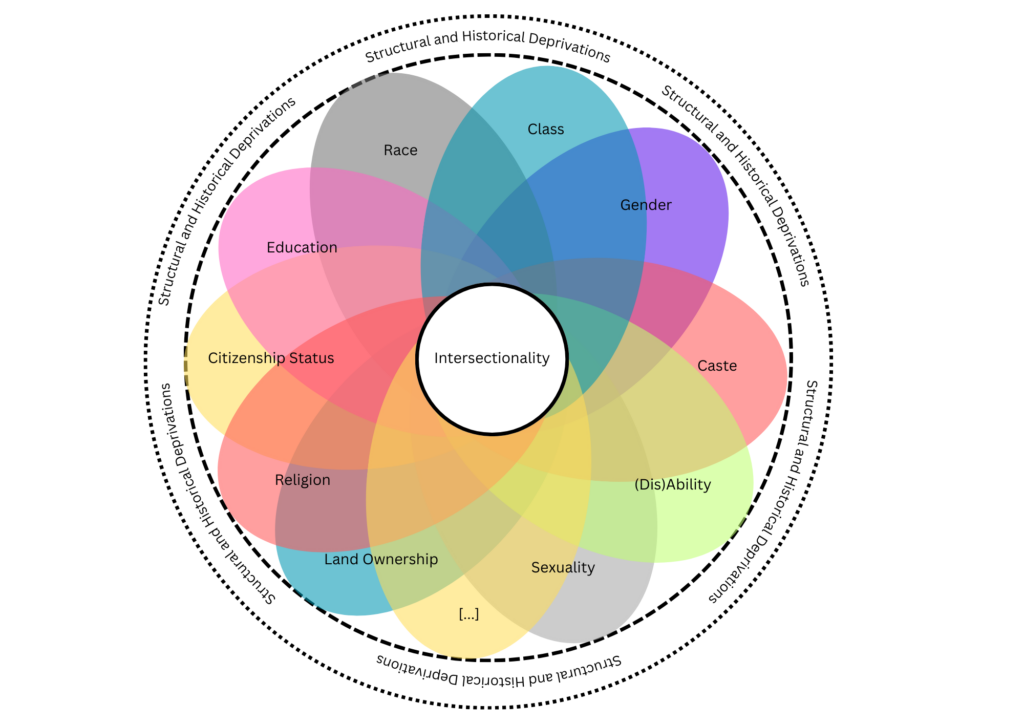
This policy brief builds on the MAPS project guidelines on intersectional justice.
Download the full policy brief below:
The full policy brief may be cited as:
Patki, P., Barlow, N., Chevallier R., Dengler, C. ,Heck, L. (2025). Rethinking Public Policy Through an Intersectional Lens. The MAPS Project, Vienna University of Economics and Business, Vienna, Austria, ZOE Institute for Future-Fit Economies.