


Recurrent taxes on net wealth were once commonplace in Europe, but only three countries continue to levy similar taxes today. Rising wealth inequality and perceived pressure on public finances have contributed to increasing debate around their re-introduction. Wealth taxes are noted in the ecological macroeconomics, post-growth and sustainable welfare literatures for their potential to manage debt and accumulation, reduce inequality and provide more growth-independent sources of welfare funding. However, detailed analysis of how different wealth tax designs could contribute to specific goals of a post-growth transition is lacking.
In a recent study published in Ecological Economics, we examine the extent to which different wealth tax designs can contribute to four goals of a post-growth transition: redistributing wealth; eradicating extreme wealth; curbing rent-seeking; and reducing CO2 emissions. These goals are derived from the post-growth and ecological economics literatures, which stress the importance of (i) achieving a more equitable distribution of income and wealth by design, rather than relying on aggregate output growth, (ii) making progress towards establishing ceilings on wealth, related to ‘limitarian’ and sufficiency frameworks, (iii) re-shaping the economy away from ‘appropriating systems’ such as finance and private provision of essential services, and (iv) lowering the CO2 emissions associated with unequal distributions of income and wealth.
The analysis is based on microsimulation modelling, using household-level data from eighteen countries of the 2017 EU Household Finance and Consumption Survey. We formulate four different tax designs, which are shown in Table 1.
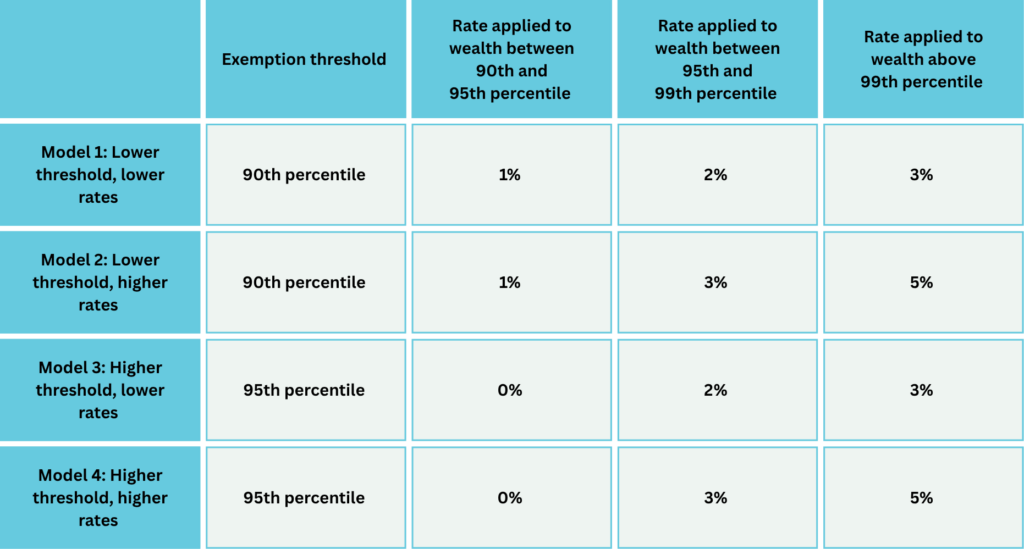
Each tax design is then applied to three different tax bases: total net wealth, combined financial wealth and ‘investment property’ wealth, and total property wealth, resulting in a total of twelve combinations.
Our analysis shows that wealth taxes can make a significant contribution to advancing the goals of a post-growth transition. For example, a net wealth tax with a lower threshold and higher rates could reduce the top 10% wealth share by 0.56 percentage points, and CO2 emissions by 0.77% in the first year. The direct effect of a lower-threshold, higher-rate tax on financial and investment property wealth would be a reduction in holdings of financial and investment property wealth of 1.72% (or approximately €500bn). Since these types of wealth are more likely to be linked to appropriating systems that extract rents for the benefit of elites at the expense of broader society, a reduction in these wealth holdings is likely to be positive from a post-growth point of view.
However, the most effective tax design varies depending on the goal of the tax.
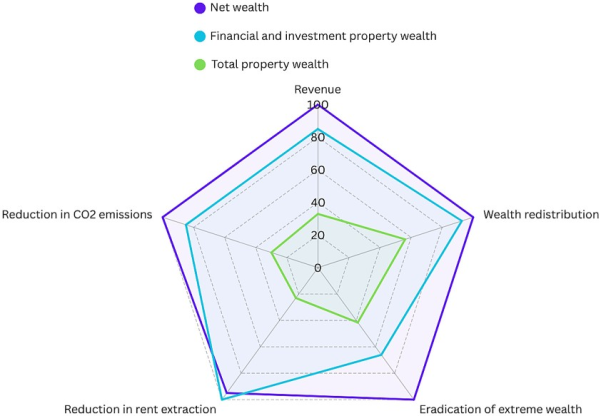
- If the goal is to maximise revenue or the amount of wealth recirculated, reduce the share of wealth held by the top 10%, reduce the number of households with ‘extreme’ wealth, or reduce inequality-related CO2 emissions, then a tax on net wealth with a lower threshold and higher rates is most effective.
- If the goal is to maximise the progressivity of the tax or reduce the share of wealth held by the top 1%, a tax on net wealth with a higher threshold and higher rates yields the best results.
- If the goal is to reduce rent extraction, a tax on financial and investment property wealth with higher rates and a lower threshold performs best (all else equal).
Figure 10 below presents some of these trade-offs visually, showing the relative effectiveness of taxes on different kinds of wealth in relation to the four goals, as well as total revenue
Trade-offs between goals and tax designs emphasise the need for holistic policy portfolios. Wealth taxes cannot serve as a standalone solution; instead, they must be embedded within broader eco-social policy packages that complement their strengths and mitigate their limitations. For instance, a wealth tax could be levied on net wealth to maximise redistribution, whilst rent extraction could be addressed through rent controls, de-commodified provisioning, and worker-owned companies.
Access the full article in Ecological Economics below:
The full article may be cited as:
Webb, T., Apostel, A., Büchs, M. and Bärnthaler, R. 2026. Wealth taxes for an eco-social transition: How different tax designs align with post-growth goals. Ecological Economics, 250. https://doi.org/10.1016/j.ecolecon.2026.109139.