

One of the main challenges of the 21st century is how to ensure a decent life for the global population while staying within planetary boundaries. Currently, seven out of nine planetary boundaries are transgressed, while billions of people are not able to meet their essential needs. The post-growth literature argues that to address these coupled challenges, societies should move away from economic growth as the main policy goal, and instead prioritise the goals of environmental sustainability, social equity, and human wellbeing. Although post-growth ideas have recently been taken up in various macroeconomic modelling studies, it remains unclear what exactly is required for models to adequately represent post-growth scenarios.
In a recent study published in Ecological Economics, we address this gap by proposing a framework of minimum requirements for a post-growth model. Based on the post-growth literature, we identified policy themes and model elements that could be relevant for modelling post-growth scenarios. Armed with this information, we surveyed researchers working in the field to identify the elements that should be considered as minimum requirements for a post-growth model. We then combined these requirements into a coherent framework that integrates the environmental, economic, and social spheres.
What is missing in mainstream models
The post-growth literature has identified various shortcomings of mainstream economic models. The first critique is that mainstream models often treat the economy in isolation from the environment, which underrepresents the systemic impacts of environmental damages. The second critique is that mainstream models often use GDP per capita as a proxy for wellbeing, although wellbeing tends to plateau beyond a certain level of consumption. The last critique relates to how mainstream models optimise for a single goal, instead of considering multiple non-substitutable goals such as sustainability, equity, and wellbeing. Given these limitations, mainstream models are unable to adequately simulate and assess post-growth scenarios.
What should a post-growth model include?
To be consistent with the post-growth literature, we argue that a credible post growth model should evaluate scenario outcomes in terms of three core goals: environmental sustainability, social equity, and human wellbeing. By combining insights from the post-growth literature with the results of our survey, we arrive at the minimum requirements for models to adequately assess these three goals. Post-growth models should integrate three spheres of analysis, namely the biophysical sphere, the economic sphere, and the social sphere.
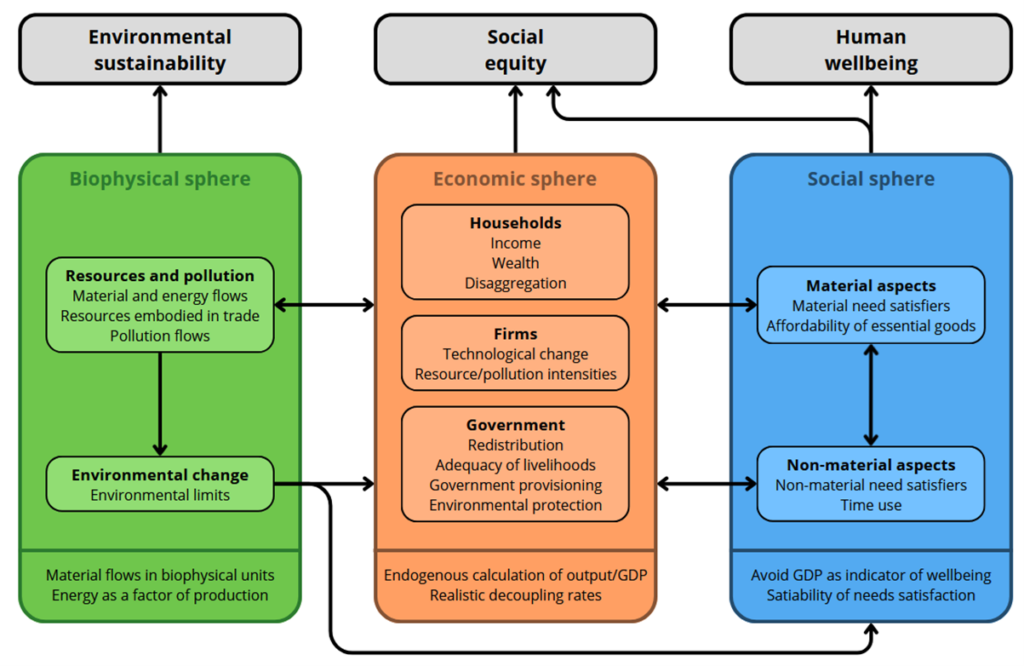
Regarding the biophysical sphere, a key insight from ecological economics is that the economy is embedded within the biosphere, which has three main implications. First, models should represent resource and waste flows, and express these in biophysical units. Second, energy should be treated as an essential factor of production. Lastly, post-growth models should represent how economic activity affects the biosphere (and vice versa) through the inclusion of feedback mechanisms and environmental limits.
For the economic sphere, we suggest that post-growth models should represent key characteristics related to households, firms, and the government. To represent inequality, households should be disaggregated across demographic dimensions (such as gender or race), tracking income and wealth per group. For firms, a post-growth model should represent resource and pollution intensities of production, the process of technological change, and be realistic about the decoupling of environmental pressures from economic activity. For the government, we identified three key roles, namely redistribution, ensuring access to essential goods and services, and environmental protection.
Regarding the social sphere, the post growth literature emphasises that wellbeing depends on the satisfaction of human needs. Therefore, models should represent both material and non-material aspects to adequately represent wellbeing. On the material side, models should include material need satisfiers and the affordability of essential goods and services. On the non-material side, models should include non-material need satisfiers and time use to represent essential, non-monetised activities like care work.
Towards modelling post-growth scenarios
This framework provides an aspirational goal and a set of guidelines for developing post-growth models. Such models are important to explore sustainable and just futures that go beyond the pursuit of GDP growth. GDP is widely acknowledged to be a poor measure of societal progress, and it may not be possible to reconcile its pursuit with environmental sustainability. Post-growth models can provide policymakers with a more diverse range of policies and future scenarios that do not rely on economic growth. Without such models, policymakers and sustainability science risk overlooking pathways that could deliver rapid emission cuts while simultaneously improving social equity and human wellbeing.
Access the full article in Ecological Economics below:
The full article may be cited as:
Van Eynde, R., Dillman, K.J., Vogel, J., O’Neill, D.W., 2026. What is required for a post-growth model? Ecological Economics 243, 108928. https://doi.org/10.1016/j.ecolecon.2026.108928